Grounding Part 1: What is Somatics?
When we honour the one-ness of mind and body, we begin to see kink not as an escape from ourselves, but as a way back into ourselves. Somatics gives us a way to understand kink not just as an activity, but as a conversation between our senses, systems, and selves.

Somatics, or Somatic Therapy, has been having a moment lately – and with good reason. The purpose of this blog is to explore kink through a somatic lens. This is part one in a 3-part introductory series Grounding, laying the groundwork for what is to come.
While the term somatics was only coined in 1976 by Thomas Luis Hanna, it is far from new. Somatic practices are rooted in ancient traditions; like yoga, tai chi and rituals in many prehistorical cultures.
Soma means "the body as perceived from within": the internal experience of the body; the nervous system, including the autonomic nervous system, the senses, and our perception of movement.
The Mind-Body
It’s important to begin with the idea that body and mind cannot be separated.
It’s easy to try to split the self into constituent parts and think of the mind and body as two separate entities; one that does and one that thinks. But in reality, they are united in one mind-body.
When people (often yoga teachers) say things like “we store trauma in our hips,” this sounds like some sort of vague mystical concept. But it is much more straightforward than it seems.
If someone is in a state of fear, they don’t only experience this fear in their mind. They have an embodied experience: they tense their muscles, their vision narrows, their heart-rate and breathing change and they may experience digestive issues.
If this state of fear continues for a long time, they may hold tension in their hips as the body strains those muscles, preparing to run or make itself smaller. After a long time like this, they have tight hips and even chronic pain: the trauma has been "stored" in their hips.
It may also be stored in the upper back, the gut, elsewhere in the body. They may experience longer-term hormonal effects or digestive issues, like IBS: the body does away with less necessary processes like digestion and reproduction when it is in survival mode.
This communication goes in both directions: from mind to body but also from body to mind. If you spend a long time with your body folded forwards (like sitting at a desk) and very little time standing or walking, your mind-body may interpret this as being in the foetal position; a posture we adopt in states of fear to protect our internal organs. As a result, you may become hyper-vigilant, anxious, or have low mood or anxiety. You may find hip-opening exercises to be incredibly emotional. People often cry in yoga postures where they open their hips, as their body begins to “release” this trauma.
This does not mean the body influences the mind or the mind influences the body. It means the body and mind are one.
Somatics in Different Fields
In physical movement fields, such as dance, gymnastics and yoga, somatics focuses on the internal sensations rather than performance. Yoga actually means "union": union of the body and mind. Spiritual movement practices like yoga, qigong and tai chi function as moving meditations.
Therapeutically, somatic coaches help clients regulate their nervous system. If you suffer from chronic pain and see a somatic coach, pain reprocessing therapist or hypnotherapist, they may ask you to practise somatic tracking, where you notice and follow internal sensations.
Kink works like this much of the time. Looking at kink somatically, we focus on internal sensations, not the performance aspect or how “pretty” it looks (though, like in dance, performance can be an important element for some people; it’s just not our focus here).
Kink often emphasises flow, breath, the union of body and mind, and energy – or, in contrast, the manipulation of these (subspace is, for many, the disconnection of the body and mind).
Kink also works therapeutically for many people. Many kinksters have experienced trauma and use kink to process, reframe, or move beyond it - this is something we will look at in more detail next week.
All of these practices help connect you to yourself by making the one-ness of mind and body more conscious through movement, breath and touch. Through heightened awareness of the nervous system, we learn to respond appropriately to input. For this reason, somatics can be incredibly effective for people who have experienced trauma, who are neurodivergent, or who live with chronic pain.
The Nervous System
Once you understand the mind-body as one, you can begin to see it as a set of interconnected systems that function and communicate together under the umbrella of the nervous system.
The Sensory System
First: the sensory system. I start here because it is how we experience the world, through our nine senses. Wait, nine?
Our nine senses are:
- Sight
- Hearing
- Smell
- Touch
- Taste
- Interoception
- Proprioception
- Vestibular sense
- Nociception
You’ve probably heard of the first five; the others, maybe not.
Interoception means our internal sense of the body and organs. It is our sense of our own heartbeat and breath, our thermoception (sense of temperature), feelings of thirst, needing to go to the toilet, and physical sensations of emotions (is that feeling of butterflies in your stomach excitement or anxiety?).
Proprioception comes from proprio (self) and ception (sense). It is our sense of our body in space: knowing where your feet are without looking, or if you can jump over something before you try.
The vestibular sense is connected to proprioception because it is also about movement, but it is governed by the inner ear and controls balance.
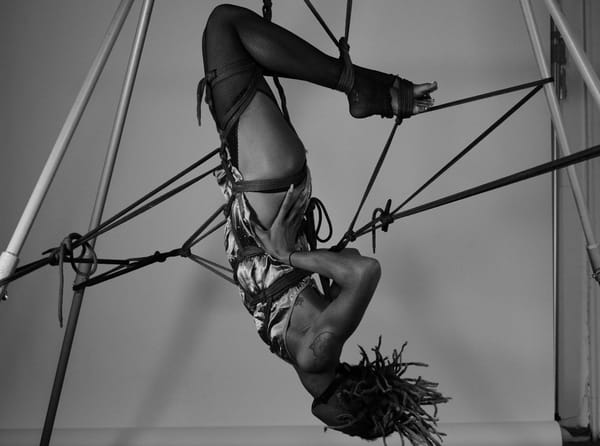
We play with both proprioception and the vestibular sense in shibari and when swinging a flogger in impact play (and in many other kink practices).
Nociception is part of our interoception but I will treat it separately because it is so important in kink: it is our sense of pain. The word comes from the Latin noci, meaning hurt. Nociception is key to masochism and many many other kink practices, and, as a pain specialist, is an interest of mine.
We also play with the more familiar senses regularly in kink, such as sight, sound and touch; through blindfolds, lighting, music, physical contact, and sensory deprivation.
The Autonomic Nervous System
Once we have sensory input, we have an embodied, involuntary response through the Autonomic Nervous System: breath, heart-rate, and instinctive movement. The Autonomic Nervous System is split into two basic states: the Parasympathetic Nervous System and the Sympathetic Nervous System; one of these is dominant at any given time. I will go into these states in much more detail in a future post, so treat this as a basic overview:
- The Sympathetic Nervous System is located in the spinal cord, and activates primarily when we feel unsafe. It is commonly known as Fight or Flight. Here, we are dysregulated: disconnected from ourselves, from others and from the present moment. We are primed to run, fight, freeze or have another fear response.
- The Parasympathetic Nervous System is primarily controlled by the vagus nerve, a highway of nerves running from the gut to the brain. The Parasympathetic Nervous System includes:
- Ventral Vagal, dominated by the upper part of the vagus nerve. This is what is dominant when we feel relaxed and regulated. It’s what is known as Rest and Digest. When we are here, we are regulated: connected with the self, with others and with the present moment.. Heart-rate is slow and steady; breathing is slow and shallow; our vision takes in the periphery.
- Dorsal Vagal, governed by the lower vagus, which connects to the gut and diaphragm. This is where we go when we are depressed, shut down, or doom-scrolling.
There are also hybrid states between these, which we will look at in more detail next month.
Other Systems
The sensory system and the Autonomic Nervous System are part of a larger network working together. The endocrine system manages hormones; the enteric nervous system manages digestion; the somatic nervous system manages voluntary movement and perception; and all of this is coordinated in the Central Nervous System.
Returning to the body; its signals, rhythms, and needs; is at the heart of both somatics and kink. When we honour the one-ness of mind and body, we begin to see kink not as an escape from ourselves, but as a way back into ourselves.
Somatics gives us a way to understand kink not just as an activity, but as a conversation between our senses, systems, and selves. When we recognise how the mind-body processes and responds to sensation, fear, pleasure, connection, and choice, we can approach kink with more clarity, safety and depth.
If this conversation sparks something in you, stay with me. There’s so much more to explore together.
Over the next two posts I will be looking in more detail at how kink is a somatic practice and how the nervous system functions during a scene.
Disclaimer: This space centres consent, autonomy, harm reduction, and nervous system awareness. I am not a doctor and this is not medical advice.
Further Reading
Can’t wait until next week? Here are some articles to deepen your knowledge on Somatic in general:
- Body Psychotherapy, or Somatic Psychology – British Psychological Society article on mind–body unity in therapy
- Somatic Experiencing: using interoception and proprioception as core elements of trauma therapy – a deeper look at the specific senses of interoception and proprioception
- Jons Hopkins have a selection of freely available somatic practice videos you can try from home
- The Trauma Research Foundation have a series of 30-minute videos, some educational and some practical, which they add to regularly
Until next week - keep on kinking!