Grounding Part 2: When Kink Becomes Somatic
When we bring our attention away from doing and into sensing, it automatically brings the focus away from chasing sensation and into experiencing sensation. Deepened awareness of the senses can make them more powerful and intense, potentially changing the scene completely.

Last week, in Part 1, we answered the question: What is Somatics.
Today, we’re going to look more at kink, and answering the question: how does kink become somatic?: how kink becomes an embodied experience and why this is a good thing.
From Doing to Sensing
For many practices that are considered somatic, there is a performative aspect to them.
In yoga, many people throw away the teacher’s instructions to listen to their body and instead try to be the one who gets deepest into the posture.
Dance can so often be so much about performance that there is a separation of body and mind in order to overcome the pain involved with dance. One fellow student-teacher in my yoga teacher training will forever have uneven hips because, as a child, she was involved in a performance in which she did a posture on one side of her body – but never the other.
Far from being a somatic practice, this type of performative movement can have the opposite effect, often leading to chronic pain.
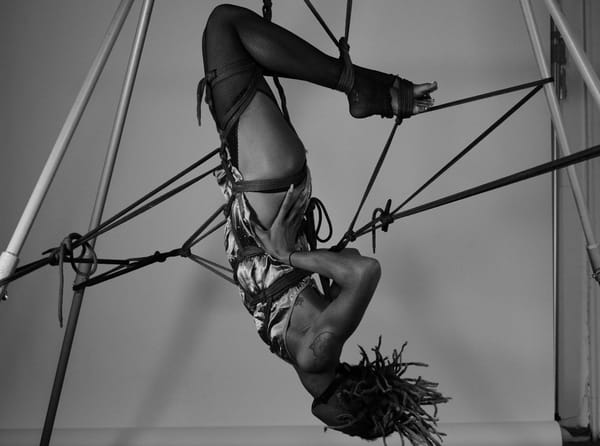
Just like with yoga and dance, kink can be performative. For many, it can be about the perfect picture to upload onto FetLife. This often leads to an objectification of the body rather than embodiment.
There is space here from a deliberate shift; from doing to sensing:
A yoga flow that unites mind and body.
An intuitive dance that brings you into yourself.
An embodied scene that shifts kink into a lived, internal experience.
Stepping away from what does it look like? we can start living the experience of what does it feel like?
Before we go any further, I do want to state that the perfect photo for FetLife is sometimes a worthy goal, and objectification of the body is something that people desire - I’ve been there! This post is not about shaming of the way some people do kink; it’s about imaging what it could be like if we decided, at least sometimes, to step into a more embodied approach.
We can also get beautiful pictures of scenes that are somatic and embodied – probably softer, more graceful, more genuine, even if not as flawless.
Attention, sensation, choice
Stepping into that embodiment involves noticing the senses we discussed last week.
Bringing your attention to your breath – is it slow or fast? Deep or shallow? How does it change?
Bringing your attention to the body – are you tensed or relaxed? How’s your temperature? What is your pain level?
Bringing your attention to your emotions – do you feel scared? Relaxed? Happy? Floaty? In control? How much? How is that the same or different from how you want to feel? How is it different from what you discussed in the negotiation?
When we bring our attention away from doing and into sensing, it automatically brings the focus away from chasing sensation and into experiencing sensation. Deepened awareness of the senses can make them more powerful and intense, potentially changing the scene completely.
Just as, most of the time, we are unaware of our breathing unless we focus on it, we can often become unconscious to sensations during a scene. Bringing our attention to those sensations can amplify them. Suddenly your pain tolerance has lowered, the rope bites harder, the way your whip-hand moves through the air is more connected.
Power, Fear and Trust
There is one glaring difference between traditional somatic practices like yoga, tai chi and dance compared to kink.
That difference is power dynamics and fear.
In kink we lean into power dynamics that cause fear and which deliberately dysregulate our nervous systems.
Just as some people choose to go on roller-coasters or take part in extreme sports, kinksters choose to dysregulate our nervous systems. It’s exhilarating, stimulating, thrilling to push your nervous system to the edge of what feels safe – and maybe just a little beyond.
But just as getting on a roller-coaster is a choice, kink centres consent.
It is within a context of consent, of deliberate negotiations and with the safety of aftercare that kinksters are able to push our nervous systems into that state of chosen, boundaried dysregulation within a felt sense of safety. In this context, fear becomes delicious and pain is tantalising.
Submission, when viewed through this lens, is not simply a “role” but is a nervous system state; a hybrid state of sympathetic nervous system dysregulation and parasympathetic nervous system regulation – balancing on the precipice of fear without tumbling into terror.
And while submission often has more pronounced nervous system effects, topping is also a nervous system state. That much power and control needs to stay regulated, so tops need to stay as much as possible in the parasympathetic nervous system, even when the pull of sympathetic activation can feel tempting. Instead, they stay with pain that doesn’t tip into unwanted cruelty, and authority that doesn’t turn into malice.
Connection and Regulation
Through this lens of trust as integral to a scene, we can see how important connection is to maintain nervous system regulation.
Often in kink, regulation isn’t something that happens deliberately but is something that is felt. It can be easier to think of regulation as connection, because, rather than checking in with heart-rate and breathing, it can often be much easier to ask yourself: do I feel connected right now? More specifically:
- Do I feel connected to myself? To my body, thoughts, feelings? Or, conversely, do I feel disconnected, disembodied, unaware of my thoughts and feelings?
- Do I feel connected to others? To those around me, whether friends, family or play partners? Or do I feel disconnected, anxious about the interactions or self-conscious?
- Do I feel connected to the present moment? To what’s going on around me; the sights, sounds and smells? Or instead am ruminating on the past or future?
We don’t need to feel connected to all three of these at once in order to feel regulated, and often in kink we feel disconnected, especially as we enter subspace. But a thread of connection is what keeps us grounded and regulated.
This connection and trust are built on a strong foundation, whether your partner is someone you have played with 100 times or it’s your first time. This foundation is built though:
- Strong negotiation: Negotiations are often simply a discussion about “what are your hard limits”, but how would the depth and intensity of a scene change if they included how you can stay regulated? How do you want to feel? How do you get there? How do you like to be touched, spoken to, interacted with? Do you want to push your nervous system today, or stay with something known and safe? All of these questions can tell your nervous system, and that of your partner(s) that I am safe, this person cares about me and I can trust them. (Stay tuned for future posts looking at negotiations in more depth!)
- Attunement. Attunement means being aware of someone else’s internal state. A partner who is checking in with you regularly – not just verbally but also reading your body language, breathing and temperature – is saying to you I notice how you’re doing, and it’s important to me. Taking time before a scene to hold each other and even breath together in sync can help with attunement. Personally, I check in with partners asking “where are you?” and answering with the red/amber/green traffic light system. When subbing, just hearing my partner ask “where are you?” immediately regulates my nervous system because I know they are attuned to me and care about my experience.
- Responsiveness. Knowing your partner’s limits through negotiation allows you to slowly approach them. Being attuned to their reactions allows you to respond to them and vary the pace, making a dance between two or more people rather than a one-way flow of energy. As a top, notice how your sub’s breathing changes, how their temperature goes up or down, if they feel clammy and how they are interacting with you. Use all of this information to vary the pace and intensity of the scene.
For example, I have an incredibly low pain threshold, but I do enjoy impact play as a bottom. I’ve only done it a few times, with people I know and trust. I enjoyed these scenes because we started with a meaningful negotiation; because the top was attuned to my reactions and slowly increased the intensity based on my reactions. Eventually, I was able to tolerate and enjoy much more, because I felt safe and, later, because I entered subspace where my pain threshold increased significantly. Without these elements, impact play would be off the table for me.
Why this Matters
Kink through a somatic lens does not delegitimise kink through a performative lens. It offers an expansive alternative which is centred in connection: connection to the self, others and the present moment.
For many kinksters, especially trauma survivors and neurodivergent people, this style of kink feels safer, more sustainable and can even become a form of healing.
Next week we’re going to look more closely at what the nervous system is actually doing in a scene; whether you’re a top or bottom, kink is nervous-system stimulation. What does that really mean?
In the meantime, I leave you with a question:
What is one thing you can do to bring more awareness to how a scene feels instead of how it looks?
Disclaimer: This space centres consent, autonomy, harm reduction, and nervous system awareness. I am not a doctor and this is not medical advice.
Further Reading
Can’t wait until next week? Here are some articles to deepen your knowledge on Somatics in kink:
- When the Body Says Yes is a 30-minute video on the somatics of pleasure
- Social and Affective Neuroscience of Embodiment is a neuroscience perspective on embodiment. While not kink-specific, it is very relevant.
- Sexual Mindfulness is a journal article on embodied sexual awareness