Grounding Part 3: The Nervous System in Kink
Every touch, word, command, sensation, and moment of stillness is input. That input is not just interpreted cognitively; it is processed through the mind-body - through systems that evolved to keep us safe, connected, and alive.

This is the third and final part of a three-part introductory series, Grounding, exploring somatics, kink, and the nervous system.
Part 1 was a vanilla introduction to what somatics is: an approach that centres lived, felt experience rather than performance or external appearance. In Part 2, we explored how kink can become somatic.
This week, I want to bring those threads together and look at what is happening in the nervous system during a scene.
Rather than starting with theory, I want to start with something simpler and more grounded:
Every scene is a nervous system experiment, whether we think of it that way or not.
Every touch, word, command, sensation, and moment of stillness is input. That input is not just interpreted cognitively; it is processed through the mind-body - through systems that evolved to keep us safe, connected, and alive. When we talk about arousal, fear, trust, surrender, control, or intimacy, we are also talking about nervous system states.
That doesn’t mean kink is “just biology.” It means biology is one of the layers through which kink is lived.
Kink means different things to different people. For some, it is sexual. For others, it is about power, ritual, connection, catharsis, creativity, or play. There is no single “kink nervous system profile,” but there is a broad, useful way to think about what scenes tend to do:
Kink is nervous system stimulation.
We intentionally create conditions that evoke strong physiological and emotional responses. We step into experiences that are designed to move us out of our everyday baseline and into something altered.
One framework that can be helpful for making sense of these shifts is polyvagal theory by Porges. It is not the only way to understand the nervous system, and it is not a settled or uncontested model. But as a map of lived experience, it can be a useful one.
A Practical Map of Nervous System States in Scenes
Polyvagal theory describes three broad autonomic states that we move between in daily life:
- A ventral vagal state, associated with connection, safety and social engagement
- A sympathetic state, associated with mobilisation, intensity and fight-or-flight
- A dorsal vagal state, associated with shutdown, collapse and dissociation
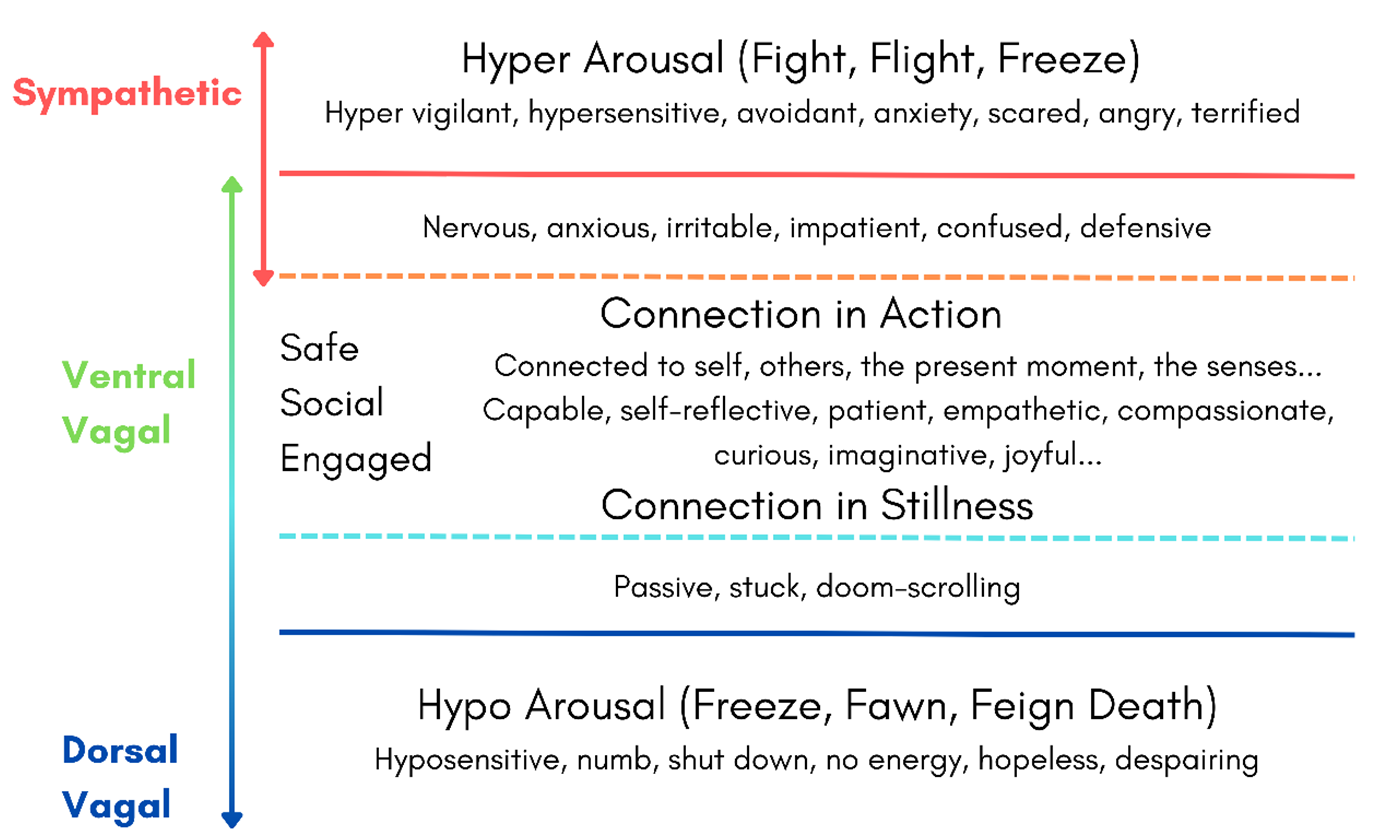
Rather than thinking of these as rigid categories, it can be more helpful to think of them as currents. We drift between them, blend them. We hover at their edges.
And in kink, we often do this on purpose.
Ventral Vagal: Connection, Presence, and Safety
In a ventral vagal-dominant state, we tend to feel connected; to ourselves, to others, and to the present moment.
In a scene, this can feel like:
- A sense of being with your partner(s)
- Eye contact that feels grounding
- A steady awareness of your body and breath
- A feeling of trust, intimacy or shared focus
This state can be deeply charged: warm, spacious, and alive. Many people experience this as the emotional core of a scene; the part that makes it feel meaningful.
For some, scenes begin here. For others, they return here between waves of intensity. For many, this state is what makes it possible to explore more challenging territory at all. For others, the goal is to stay here, because it is safe and it is comforting.
Sympathetic: Intensity, Edge, and Mobilisation
When we move into a sympathetic-dominant state, the nervous system mobilises. Heart rate increases; attention narrows; sensation sharpens.
In scenes, this can feel like:
- The edge of fear or thrill
- Heightened pain or pleasure
- A sense of being driven, focused, or compelled
- The feeling of being pushed, challenged, or tested
This is often the territory people associate with edge-play.
What matters here is not just the intensity itself, but the context in which it happens. For some, sympathetic activation feels exhilarating and delicious. For others, it feels overwhelming or unsafe – even with someone they trust. The same sensation can land very differently in different nervous systems.
This is one of the places where consent is not just an ethical principle, but a physiological one. Negotiation, trust, and attunement can create a thread of safety that allows someone to move into sympathetic activation without tipping into panic.
It is also worth naming that choosing not to go here is just as valid as choosing to go here. Not every nervous system wants intensity. Not every scene needs an edge.
Dorsal Vagal: Shutdown, Softening, and Dissociation
At the other end of the spectrum is dorsal vagal-dominant experience. This is often described as shutdown, collapse, or dissociation, but in practice it can show up in a range of ways.
In scenes, this can feel like:
- Floating, drifting, or fading
- A sesne that time is stretching on forever - or passing faster than usual
- A sense of stillness, emptiness, or quiet
- Lowered senses, including pain
For some people, this state is deeply soothing. For others, it feels unsettling or frightening. Like sympathetic activation, it can be entered intentionally or accidentally.
Slow, repetitive, rhythmic input, like rocking, stroking, steady pressure, quiet presence, can sometimes guide someone gently toward this softened, low-energy state. On the other hand, spending a long time in high-intensity sympathetic activation can also lead the body to “drop” into dorsal vagal as a kind of metabolic brake.
Altered States
In kink communities, we often talk about altered states: subspace, topspace, trance, float, drop. These words point to experiences that feel qualitatively different from ordinary waking life.
These experiences are often treated as mysterious or mystical. For some, that language is part of the appeal.
Another way to approach them is that these altered states are patterns of nervous system organisation.
Subspace
Subspace is usually described as an altered state experienced by bottoms during some scenes, and is often sought-after.
People often report:
- A sense of floating or drifting
- Thinking less, or less clearly
- Increased pain tolerance
- Feeling less verbal
Most of the research on subspace links it to transient hypofrontality: a temporary downregulation of the frontal and prefrontal cortex; parts of the brain involved in executive functions like planning, self-monitoring, and sustained verbal thought. This state normally arises in endurance sports, meditation, and flow states.
There are a small number of studies on altered states in BDSM, and far more research on transient hypofrontality in exercise and performance. The idea that subspace and transient hypofrontality are the “same thing” is a theoretical bridge; not an established fact.
That said, the overlap in felt experience is striking: reduced inner dialogue, altered time perception, changes in pain processing and a sense of absorption.
Polyvagal theory and transient hypofrontality may be describing different layers of the same coordinated shift.
From the bottom up, a felt sense of safety and connection create physiological “permission” for intensity without panic.
From the top down, transient hypofrontality softens executive control, leading to reduced self-monitoring and verbal thought, altered time perception and increased absorption.
This is not a settled theory. It is one way of making sense of overlapping patterns across different fields.
In this view, subspace is a context-dependent altered state that can emerge when intensity, trust and attention converge.
At the same time, it is crucial to hold the ethical edge here: some of the signs of subspace can look very similar to signs of overwhelm or triggering, and vice versa – attunement and communication matter far more than any theory.
Topspace
Topspace is talked about less than subspace, and studied even less. But many tops describe their own altered state during scenes.
People often report:
- Intense focus
- A sense of responsibility
- Time distortion
- Feeling “locked in” to their partner’s responses
Rather than a softening of cognitive control, this often feels like a sharpening of it. There is absorption, but also monitoring. Research links topspace to a flow state: a regulated, ventral vagal-dominant focus. The nervous system stays calm enough to track safety, consent, and shifting cues, even while the scene itself may be intense.
This is where power in kink shows up not just as an erotic or symbolic dynamic, but as a nervous system task. Holding someone else’s vulnerability requires regulation, not just confidence.
Aftercare: Returning to Regulation
If scenes are ways of moving the nervous system away from baseline, aftercare is how we find our way back.
This is not an “extra” or a courtesy. It is part of the experience.
Aftercare looks like many different things, whether we focus on touch, connection, stillness, snacks or reassurance. Different minds and bodies need different things: closeness; space; silence; conversation: there is no universal script.
What matters is not the form, but the function: supporting the nervous system back toward a felt sense of safety and connection.
This is also something to think about in the days after an intense scene or event: dropping not just immediately after a scene, but the next day, is common. Plan to check in with partner(s) and to be kind to yourself.
The role of aftercare in the minutes, hours and days after a scene is so important that it should be negotiated and valued at the same level as the scene itself. (This is a topic for a future series!)
Learning from Our Nervous Systems
My plan for SomatiKink is to publish something three weeks out of four, so next week will be an off-week.
This gives you two weeks to notice.
Noticing your nervous system in a scene – or just in general. Not so you can change anything or tell yourself off, but just to notice:
- Where does my attention go when intensity rises?
- What helps me feel more connected?
- What helps me feel more grounded?
We are building awareness and noticing patterns, not pathologising them.
When we return, we will begin a new three-part series on nervous system play: how kink can be a way of learning from our nervous systems, not just stimulating them.
Disclaimer: This space centres consent, autonomy, harm reduction, and nervous system awareness. I am not a doctor, and this is not medical advice.
Further Reading
Can’t wait until next week? Here are some articles to deepen your knowledge on Somatics in kink:
- The study I quoted most for this post was Kembler et al’s 2016 study on BDSM and altered states (subspace, topspace)
- If you’re interested in transient hypofrontality, this article does a good (vanilla) explanation
- This article looks at aftercare in more detail