Play Part 1: Mapping the Territory
Kink often isn’t about entering one state, but about intentionally moving between states while maintaining connection. Looking at the descriptions of the different nervous system states, ask yourself, Where am I during a scene that I’m enjoying?

I started SomatiKink because I had been thinking a lot about how the Autonomic Nervous System maps onto kink dynamics. For me, this deep dive has added another dimension onto my kink practices which feels very autonomous, curious and fulfilling. This is a three-part series exploring the deep dive I have taken.
Disclaimer
Before I start, I want to begin with a disclaimer that polyvagal theory, which this series is based on, is just that: a theory, created by Dr. Stephen Porges to explain physiological changes in our body. It often over-simplifies things or leads people to jump to conclusions. However, when used as a theory, it can be a useful framework through which to view how our bodies react in moments of fear, and (for this post), during kink scenes.
Mapping the Territory: The Autonomic Nervous System
The first series, Grounding, introduced the idea of the autonomic nervous system; a part of us which is key to our survival as a species and what kept all your ancestors alive long enough to allow you to exist right now. I’ll start with a brief recap before we move onto the deep-dive.
The Autonomic Nervous System involves three main states that shift and adapt unconsciously based on how safe we feel.
The three states are relaxed, when the ventral vagal pathway of the Parasympathetic Nervous System is dominant; mobilised, when the Sympathetic Nervous System is dominant, and immobilised, when the dorsal vagal pathway of the Parasympathetic Nervous System is dominant.
The reality of the autonomic nervous system is not all-or-nothing, but, as with most things, different states can occur simultaneously.
Throughout the day we switch easily between these three states. When you’re in the gym or presenting at a meeting, your nervous system is probably mobilised in a good way. Likewise, when something triggers you, that same state of mobilisation may be activated. When you are daydreaming, it is probably immobilised, but similarly, when you’re stuck doom scrolling, it’s also immobilised. And when you’re spending time with people you love, or doing something you love, your nervous system is most likely relaxed.
In between these states are hybrid states.
In the space between ventral vagal and dorsal vagal is a hybrid state of connection in stillness, and in between ventral vagal and sympathetic is a hybrid state of connection in action:
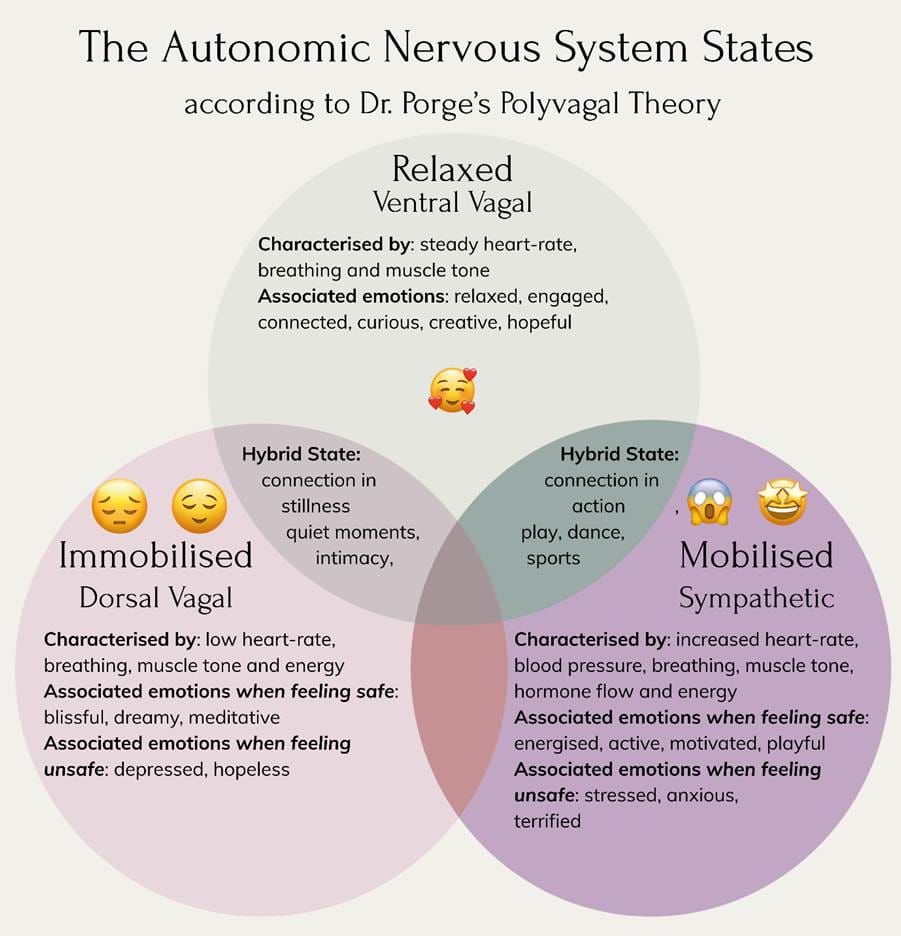
It is these hybrid states that we play with in kink. We try to keep at least one toe in ventral vagal to maintain that feeling of safety while pushing other elements into mobilisation or immobilisation.
Let’s look at the three states in terms of kink:
Safety and Connection: Ventral Vagal
As we discussed in Grounding, The Ventral Vagal Pathway of the Parasympathetic Nervous System is what is dominant when we are feeling safe and relaxed, and it’s characterised by connection and regulation.
When I talk about connection, I mean connection with the self, connection with the present moment and connection with others.
This connection has all the hallmarks of kink. Usually, when I practice kink, the present moment is all that matters. I feel so connected with my body, with my sensations, with my breath. I feel deeply connected with those I practice kink with; my partners and the kink community.
When I talk about regulation, I mean nervous system regulation. When the parasympathetic nervous system is dominant, it looks like slow, shallow breathing; a relaxed, steady heartbeat; a gaze which takes in the surroundings and peripheries of your vision.
Now, kink doesn’t always look like this regulation. Often when we practice kink, our heart-rate is elevated; our breathing may be deep and long or short and shallow; our vision may be singly focused on one thing. These are hallmarks of another state of the Autonomic Nervous System: the Sympathetic Nervous System.
Fight or Flight: The Sympathetic Nervous System
The Sympathetic Nervous System kicks into gear when we are energised, including when we feel unsafe. This is the part of us which ran from lions and bears, fought to survive, and found the things that would save our life. We owe a lot to the sympathetic nervous system but in today’s society, with no lions or bears but endless emails and group chats, many people have dysregulated nervous systems, ready to mobilise into Sympathetic at the mere sniff of danger.
When our nervous system shifts into the Sympathetic Nervous System and we feel unsafe, have a fear response: fight, flight, freeze, fawn.
While kink is based in connection, there are also elements of these fear responses, because the nervous system responds to perceived threat, even when cognitively we know we are safe – even when we specifically requested to feel the fear.
For many, behaviour in a scene involves fight, flight, freeze or fawn to some degree. Kink may also be about choosing to put yourself in a position where you can face the fear without having a fear response, because you know that you are safe, that you are with people you trust.
We also see physical changes in the parasympathetic nervous system: our heart-rate increases, to pump blood around the body ready to run or fight. Our breathing changes to bring more oxygen to the muscles. There are many of these physical elements of the sympathetic nervous system involved in kink.
Disconnection and Subspace: Dorsal Vagal
The third state of the nervous system is the Dorsal Vagal Pathway of the Parasympathetic Nervous System. This can also be how our body responds in moments of unsafety, when we play dead, feign death. In this flop state, we do not have the connection that is key to nervous system regulation. We are disconnected from the present moment, unaware of things; we are disconnected from the self, feeling less, both physically and emotionally, as a defence mechanism; and we are disconnected from others, We go into Dorsal Vagal when fear response has failed, or when we are depressed; when it feels like nothing matters.
For some, subspace has some of the elements of this part of the Autonomic Nervous System. Subspace is a term used in the kink community to describe the altered state some people reach when submitting. For many, it is sought-after and highly pleasurable to experience.
When I go into subspace I become much less sensitive, physically; and I have noticed that of others too. I can handle more pain in subspace, and also orgasm less easily. This is a sort of disconnection from the self and the present moment, a defence mechanism to get us through a scary or dangerous situation.
People describe subspace as being “floaty” and “dream-like”. For some people it feels like you’re defying gravity, for others like you are heavy and sinking. A friend of mine described it as like “swimming through treacle”. While everyone has a different description, I would argue that these all have something in common: disconnection. When we enter subspace we become disconnected from the present moment and enter an altered state. We disconnect from our own body and from those around us. I have come out of a very intense shibari scene to look up and find about 15 people watching (consensually of course). I had been so disconnected from the room around me that they weren’t a part of my experience. This was the disconnection element of dorsal vagal I was experiencing – while still feeling regulated and safe; a hybrid state.
Hybrid States
Kink often isn’t about entering one state, but about intentionally moving between states while maintaining connection.
Looking at the descriptions of the different nervous system states, ask yourself, Where am I during a scene that I’m enjoying?
Are you fully in ventral vagal? Completely calm and collected and regulated?
Are you fully in the sympathetic nervous system, terrified and panicking?
Are you fully in dorsal vagal, disconnected and despondent?
Or are there elements of multiple states involved in the scene? Are you experiencing fear within the boundaried safety of connection?
Why This Matters
Only you can answer these questions, and the answers will be different for everyone. Maybe in some, or all, scenes you stay completely in ventral vagal, connected and intimate. Maybe sometimes you like to push into those hybrid states. Maybe sometimes terrified is an emotion you want to feel in a scene.
All of these are legitimate answers; what’s important is the self-inquiry, the curiosity, the self-knowledge, and the communication of this.
Once you understand your own nervous system and what feels safe (or unsafe); what you would like to feel (or not feel) – both physically and emotionally – you can start having deliberate scenes where you explore this, with partner(s) who understand what the point of the scene is, at a nervous system level.
To get there, first we need a map. What does my nervous system do, how does it react?
That’s what we’re going to do next week.
Disclaimer: This space centres consent, autonomy, harm reduction, and nervous system awareness. I am not a doctor and this is not medical advice.
As well as reading on FetLife you can read posts at my website or receive them straight to your email! Sign up here:
Further Reading
Can’t wait until next week? Here are some articles to deepen your knowledge on Somatics in kink:
· This paper explores BDSM as leisure.
· This post from Rewriting the Rules is all about how to communicate your desires.
· This is a cool exercise in discovering your sexual values – and could be easily adapted to be “kink values”.