Play Part 2: Capacity for Kink
We go into a kink scene with the intention of playing with elements of the sympathetic nervous system: a little bit of fear, an elevated heart-rate, intense focus. Or maybe playing with elements of dorsal vagal: disconnection, a lowered heart-rate, floaty feelings.
Last week, we mapped the nervous system and looked at how this shows up in a scene. This week, we’re going to extend that by looking at our window of capacity and also make it personal, helping you to map what happens in your nervous system in your scene.
This week's post includes an exercise you can complete with a workbook I created. This is completely optional – you can still gain a lot from the exercise without the workbook. The workbook allows a level of curiosity with longevity that is hard to reach without it. You can access the worksheet for free here:
Nervous System Play
We go into a kink scene with the intention of playing with elements of the sympathetic nervous system: a little bit of fear, an elevated heartrate, intense focus. Or maybe playing with elements of dorsal vagal: disconnection, a lowered heart-rate, floaty feelings. We do this by purposefully creating fear, or other usually unwanted emotions, in the boundaried regulation of a negotiated scene.
The key to this, though, is that we (almost always) don’t want to fully go into either the Sympathetic Nervous System or Dorsal Vagal. We don’t want to have a complete fear response; we just want to play with that response. We want to stay in the hybrid states, picking and choosing the elements we want to experience.
Here is another way of conceptualising the Autonomic Nervous System:
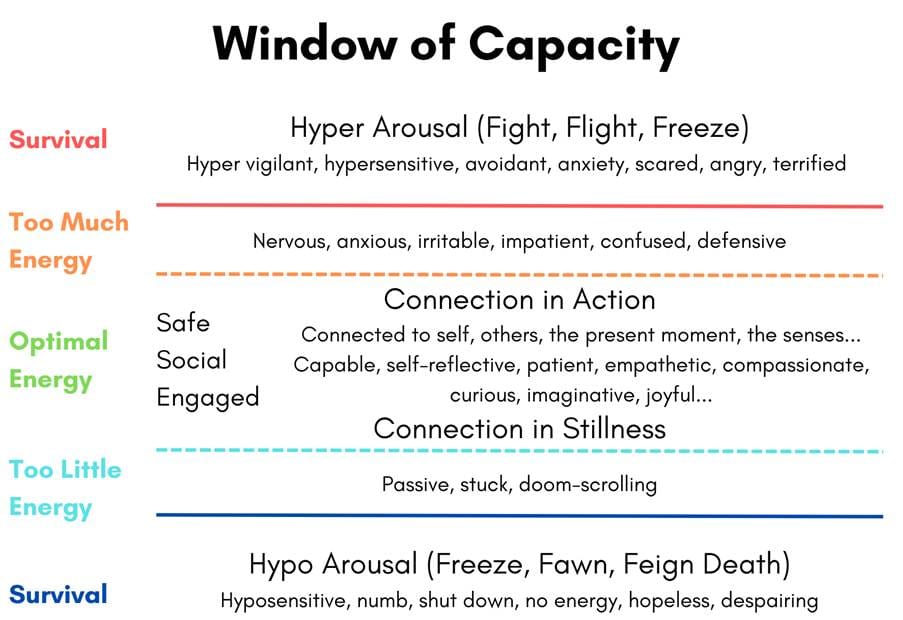
Here, you can see the three states on a continuum from immobilised (at the bottom) to mobilised (at the top). In the middle is our Window of Capacity.
You may have heard this called the window of tolerance, but I prefer the name window of capacity because it refers to our capacity for things instead of ability to tolerate things. I relate to this more, as a neurodivergent person who was taught to mask and tolerate things, and not taught a whole lot about my capacity for positives.
The capacity we are talking about here is the capacity for connection (to self, the present, others); the capacity to be playful or joyful; the capacity to get stuff done (go shopping, work, go to the gym) – to name just a few.
Now, what happens when someone whose nervous system is regulated becomes dysregulated?
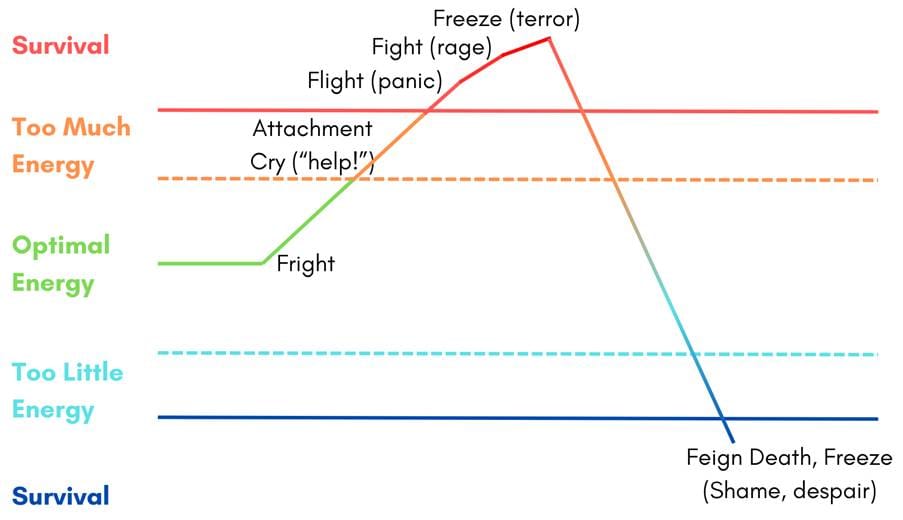
This line shows what happens when someone who is regulated gets a fright:
First, they have an attachment cry – they shout for help, look for someone.
If this does not work and their nervous system is not reassured, then they go into survival mode: this is the sympathetic nervous system. They cycle through flight, fight, freeze, (and, not shown here: fawn), trying to survive the situation.
And, if these don’t work, they crash down into dorsal vagal – they need to reserve energy because these fear responses haven’t worked or are too draining, so in dorsal vagal they feign death and freeze.
You may notice there are two freeze states; one in sympathetic and one in dorsal vagal. When we freeze in a state of fear and activation, the muscles are tense, heart-rate is high, and the body is ready to run or fight should the opportunity present itself. Meanwhile, in dorsal vagal, the muscles are limp, heart-rate is slow and we feel despondent. Both are survival responses which may look similar from the outside but are very different to the person experiencing them.
This line visualises just an example of what might happen. Not only does everyone go to different fear responses based on things like their neurotype, their upbringing, trauma and their attachment style, but these responses also vary according to context.
How does this relate to kink?
In a scene, we aim to embody many of the elements of regulation, but often also some of the elements of dysregulation.
We switch between being connected in action (play, energy, fun) and being connected in stillness (intimacy, gentleness, caresses).
But we may also want to push our nervous system up into dysregulation at the top and the bottom of our window:
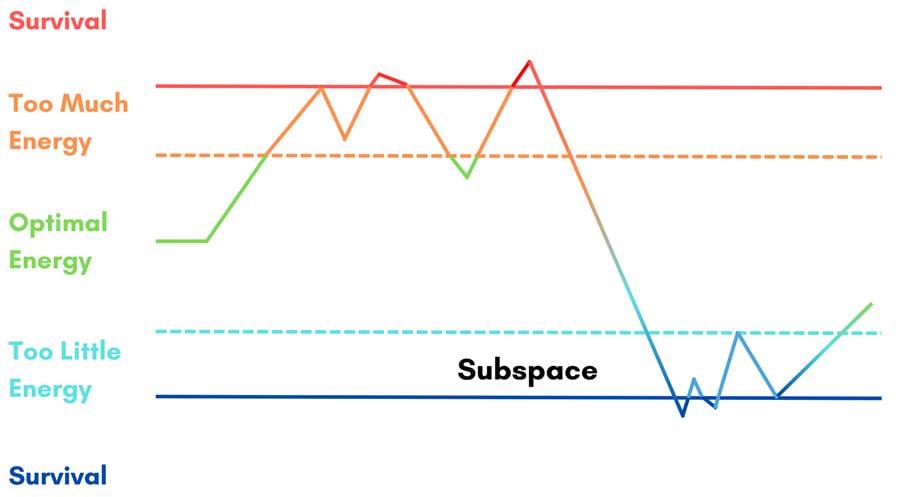
If the line above is the nervous system of the bottom in a sadomasochistic scene, they start in a place of regulation on the left. Then as the scene picks up – as they start to feel fear, and pain, their nervous system reaches a place of activation. Notice the line stays mostly in the hybrid state – still in ventral vagal, but pushing up into survival a few times.
An attuned top, dealing out the fear and pain, helps them to regulate when it risks coming too much – these are where they drop back into their window of capacity. But this attuned top also knows their sub wants to push themselves; wants to feel real fear today. So they push their sub’s nervous system up into survival – just a pinch; just a morsel of that fear.
And, when this dance of regulation and dysregulation reaches its fever pitch; when the bottom has switched between the regulation of trust and the fear of pain for long enough… their nervous system taps out and they drop down into dorsal vagal, and subspace. From here, the scene is drawn to a close and the aftercare takes over. An intimate connection in stillness that is essential to bring both partner’s nervous systems back to a place of regulation.
This is just an illustrative example: apply it to impact play, or rope, or many other things.
But why?
We do this, I think, for different reasons.
It’s invigorating, energising; playing like this. It’s fun, and it reminds you that you’re alive.
The cocktail of hormones (adrenaline, dopamine, oxytocin…) that the nervous system uses to regulate can feel intoxicating.
For some neurodivergent individuals, nervous system play is an extreme form of stimming. Neurodivergence is, after all, divergence of the nervous system, so it makes sense that people with hyper- and hyposensitivity would play with that.
Many people who practice kink have experienced trauma, and nervous system play can be a way to reframe that fear response in a way that feels safe. While kink is not therapy, it can be reparative when done consciously.
There are many other reasons, but, no matter what the reason is, it’s essential that elements of a regulated nervous system are present in the scene. Without regulating your nervous system, you risk having a real fear response and becoming triggered.
So – what does this mean for kink?
In kink, we are not trying to dysregulate ourselves.
We are playing at the edges of our capacity, while staying connected.
Understanding your nervous system means understanding how you can achieve certain feelings, states and experiences; and, perhaps more importantly, how we can avoid others.
Mapping Your Nervous System in a Scene
An interactive exercise
We started off last week with a general overview of the nervous system, but every nervous system is different, and every scene is different.
If you want an understanding of the nervous system to influence your body and your scenes, we need to map your nervous system.
You can do this alone, just thinking through it, or, if you want to get nerdy about it, you can work through an exercise I created, which allows for more depth, curiosity and longevity.
Some people may find this exercise difficult – alexithymia, or the inability to identify emotions, is something a lot of neurodivergent people experience, as well as people who have experienced trauma. I have put examples throughout this exercise to help – but try to think of these as support only if you are struggling to name your own experience. Before you read the examples, try to think about your experience, so you’re not swayed by the experience of someone else.
Step 1: My Nervous System
First, describe the three main states and what they look like for you. Take your time, and be prepared to come back to this another time, to give the question time to land in your body.
· What does Ventral Vagal look like for you? (calm, confident, playful…)
· How does it feel? (relaxed heart rate, regular breaths, open chest…)
· What does Sympathetic look like? (scared, stressed, overwhelmed…)
· How does it feel? (increased heart-rate, shorter breaths, tension…)
· What does Dorsal Vagal look like? (numb, heavy, disconnected…)
· How does it feel? (slow heart rate, shallow breathing, collapse…)
Identifying what these states look like allow you to identify them faster when you’re in them, and understand your scene better. If you’re doing the workbook, you can complete the empty nervous system map on page 5.
Step 2: My Wants and Needs
Next, identify the parts from each state that you like or need during a scene. You can highlight these in the workbook - still on page 5:
For example,
· I like to feel confident.
· I need to feel connected.
· I like to feel scared but to get there I need to feel safe.
You can also identify the parts you dislike or are boundaries or hard limits. Highlight these a different, contrasting colour in the workbook.
· I never want to feel terror.
· Disconnection from my partner(s) is triggering.
This is a self-knowledge we build slowly over time; so for now, put the workbook to one side (we'll continue with it next week!).
All of this is something we build on over time: when a scene goes well, or when it goes wrong, we can approach it with curiosity and use that to add to this list.
This is a good start for understanding what is going on during a scene and can also be a good jumping off point for negotiating scenes that feel amazing.
That’s what we’re going to look at in the third and final part of this series next week, because your nervous system is not an obstacle to your kink. It’s the instrument.
Disclaimer: This space centres consent, autonomy, harm reduction, and nervous system awareness. I am not a doctor and this is not medical advice.
If you're not yet signed up to get these posts straight to your inbox, you can sign up here:
Further Reading
Can’t wait until next week? Here are some articles to deepen your knowledge on somatics in kink:
· This post looks at the window of tolerance (aka capacity) in more detail.
· This article looks at the healing power of somatic kink.
· This article looks at fear-arousal pathways, comparing fear in kink to the joy of watching horror movies.