Play Part 3: Learning from our Nervous Systems
Mapping our nervous system in a scene in the way we have in this series is the start of a journey of curiosity. This self-knowledge and self-inquiry will hopefully lend your scenes a new edge to explore, and a new way to think about yourself and your kinks.
In the previous two posts in this series, we have looked at ways in which we play with nervous system states in kink, and we mapped our own nervous systems during a scene.
This kind of insight can bring increased awareness of a scene, allowing us to it in directions you want to.
When we understand what types of touch are reassuring and which are fear-inducing, we can use both of these to play with the nervous system. If this zigzag line (or something similar) is the goal of a scene, how can you and your partner(s) create that?
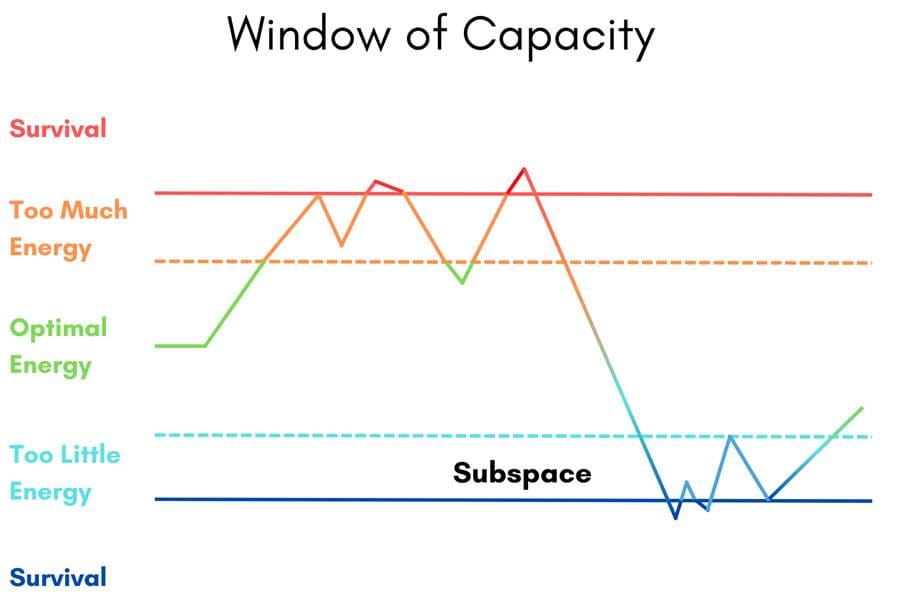
To work that out, you need to do some more soul-searching. If you completed the exercise last week, you should have a map of your nervous system (a living document that will change as you change and as you learn more about yourself), along with a list of your nervous system likes and dislikes in scenes. We’re going to continue this exercise now - if you don’t already have it, you can download the workbook here:
Triggers and Glimmers
Reflecting on your list of nervous system likes and dislikes from last week (page 5), think of some of the ways you reach those feelings, and take a note of them. These are glimmers (things that help you regulate) and triggers (things that activate your nervous system). This is unique to you, but some examples might help:
· I need to feel calm -> I get there with quiet and flowy music
· I need to feel safe -> I get there when my partner checks in with me
· I want to feel scared -> I get there before my partner inflicts pain
· I don't want to feel anxious -> I get there when I know people are watching
You can complete this on page 5 of the workbook.
Now we have a framework to play with. Triggers and glimmers become boundary cues we can deliberately explore or avoid. The next step is to understand how we can use this information to create scenes that have the needs, avoid the triggers but play with the other stuff as much as feels good for you.
Firstly: regulation
Starting the scene regulated is ideal. Having regulation to come back to as needed is essential. You and your partner(s) need to understand what regulates you so that you start feeling safe and connected and so that you can return here if you want to.
Regulation means connection: what can you and your partner(s) do to increase and enhance connection during a scene? This includes starting the scene connected as well as bringing someone down from sympathetic or up from dorsal vagal.
Think about your own scenes and what feels good before you read my examples – this builds awareness of your body and nervous system. Use these to complete the ventral vagal section (marked with a 1) of page 7 of the workbook.
Then you can come back and add some more ideas to the same section if they feel right for you:
· Breathe together before or during a scene
· Eye contact
· Different types of physical touch
· Slowing down
· Identifying the exit(s) and your route to the exit(s) before starting the scene. This can subtly tell your nervous system it’s safe and there’s a way out – even if you’re restrained!
· Focusing on sensations (the sensation of the rope, the sensation of breath, the sensation of the impact play…)
· Focusing on other senses (the smell of candles, the music playing, the light in the room, the taste of your partner’s kisses…). Remember that balance (vestibular), pain (nociception), temperature (thermoception) and the sense of your body in space (proprioception) are also senses, and can be especially fun to focus on in kink
· For some of us, especially neurodivergent folx, sensory overwhelm happens when you can’t filter out the senses and get them all at once. If this happens, try focusing on just one, soothing sensation to help the others fade into the background (this can include a stim)
· Communicate with your partner(s)
· This communication needs to include changing or stopping a scene if anyone wants. Practice saying “I need a break,” “I need this to change,” or “I need to stop,” if this is difficult for you. Practice saying “thank you for letting me know,” “what do you need from me?” or “okay, let’s stop,” if you find that difficult.
Regulation is the core of the scene, no matter where else you go. A deep understanding of what regulation looks like for you and how you can return to it can make playing with your nervous system in scenes more fun and explorative.
Next: mobilisation
Once you have established the boundaried safety of a scene, you can think about how you might want to mobilise your nervous system towards sympathetic in a way that feels safe enough. What ways do you want to push your nervous system, and how can you do that? Of course, every scene is different and this mobilisation might look different depending on your mood, the dynamic, the kink, who you are playing with, the context, and more. This is just about curiosity for now, but, if you’re completing the workbook, you could complete it a few times (e.g. topping and bottoming or one for rope bottoming, one for impact play topping…)
Here are some questions you could ask yourself:
· Which Sympathetic Nervous System fear responses (fight, flight, freeze, fawn, find) do I want a little bit of? Which of them do I want to avoid?
· How can I get there?
· What do I need for that to feel safe enough for me?
· Which types of disconnection do I want to explore in terms of mobilisation? (hurting/being hurt (how?), degradation or humiliation, sensory deprivation, etc)
The answers to these questions will probably just be your kinks, but might also reveal something else. For example, maybe you can only experience a certain kink when your nervous system is already in a certain state. Perhaps degradation feels and sounds horrible until your nervous system is mobilised and then it’s something you enjoy. How can you build this into a scene, and how will you communicate this to partners? Again, build that awareness of your own scene, and complete this in the sympathetic part of page 7 of the workbook (marked 2 and 3). You can use these examples to help if you’re stuck.
· Sharp pain feels good (fight response - bratting)
· Thuddy pain is triggering (freeze response)
· Energetic music feels good but quiet enough that I can communicate over the top of it
· Being restrained with my arms behind me is delicious
· Being restrained in a backbend is triggering
Nervous system activation can be fun in a scene, but it can also be scary or even triggering. Knowing what elements of an activated nervous system are desirable, and which are not, can help you play with this state in a safe, curious way.
Mobilisation is at the active end of our nervous system; the other side of that coin is the immobilisation of dorsal vagal.
Immobilisation
From that safe, boundaried connection of ventral vagal, you may want to immobilise your nervous system towards dorsal vagal in a way that feels safe.
Here are some more questions to ask yourself:
· What helps me get into subspace? How can I get there in a way that feels safe?
· What elements of dorsal vagal do I want to experience? Which ones do I not want to experience?
· How can I get there?
· What do I need for that to feel safe enough for me?
· Which types of disconnection do I want to explore in terms of immobilisation? (denying/being denied touch or kisses, sensory deprivation, etc)
Take a moment to reflect on your own experiences and complete the dorsal vagal section of page 7 of the workbook (marked 4 and 5). You can take inspiration from some examples:
· When I feel overwhelmed with physical touch I go into dorsal vagal
· If an intense rope scene lasts a long time and I am tied and untied, I start to go into subspace
· Intense pain makes me disconnect (and I like it)
Playing with elements of dorsal vagal can feel amazing in a scene, but can also feel disconnecting and triggering. Understanding your dorsal vagal in your own nervous system can help to keep scene safe, fun and intimate.
What Next?
Mapping our nervous system in a scene in the way we have in this series is the start of a journey of curiosity. This self-knowledge and self-inquiry will hopefully lend your scenes a new edge to explore, and a new way to think about yourself and your kinks.
We can use these nervous system maps to negotiate scenes in more depth, in a way that honours your nervous system and brings the scene closer to what you need and want.
We can also use them to expand our understanding of aftercare and its role, and give and receive the kind of care that supports our nervous systems to return to regulation.
Next week is a week off, and I invite you to take this time and build the self-knowledge we have been working on in this slowly, exploring different aspects of your nervous system and your kink. When we return we will be looking at trauma in a 3-part series; understanding how trauma impacts the nervous system and how that comes out in a kink setting.
Disclaimer: This space centres consent, autonomy, harm reduction, and nervous system awareness. I am not a doctor and this is not medical advice.
As well as reading my posts on somatikink.co.uk, you can receive my posts straight to your email!
Further Reading
Can’t wait until next week? Here are some articles to deepen your knowledge on Somatics in kink:
· Deb Dana’s website Rhythm of Regulation has some free resources on Polyvagal theory.
· Body Electric has a host of workshops (free and paid)
· You can now check out my resources page for a curated list of resources and further reading.