Neurodivergence Part 1: What is Neurodivergence?
The word neurodivergence comes from neuron, as in nerve, mind-body, relating to the nervous system, and divergence, meaning differing from the norm. So neurodivergence is a nervous system that differs from the norm.

As someone who is AuDHD (autistic and ADHD), it really seems that everyone I know is neurodivergent.
While some people will tell you that this is all down to TikTok… I (not so) politely disagree.
This is a two-fold situation:
Firstly, more people are being diagnosed as, identifying with, self-discovering their neurodivergence. This is because the definition of autism changed to incorporate a broader range of traits not so long ago, and because people are more educated about neurodivergence. It’s not the case that people are watching one TikTok video, labelling themselves and moving on. Being neurodivergent, they take a deeeeep dive into the research, do a million online screeners, talk to their friends and their therapist, potentially pursue a diagnosis (if they can afford it, if it makes sense for them, if they think this will be helpful) – and still get imposter syndrome.
Secondly, while everyone I know seems to be neurodivergent, that doesn’t mean everyone is neurodivergent. Neurodivergent people tend to get on better with each other, are 10-12 times more likely to date each other and are drawn to the same activities and interests.
Such as kink.
Kink is a haven for many neurodivergent people.
But to understand why, we first need to understand what's actually going on in a neurodivergent nervous system.
What is neurodivergence?
The word neurodivergence comes from neuron, as in nerve, mind-body, relating to the nervous system, and divergence, meaning differing from the norm.
So neurodivergence is a nervous system that differs from the norm.
ADHDers have an interest-based nervous system. We do the things that trigger dopamine, a hormone that feels good and is motivating.
Autistic people have a divergent nervous system characterised by hyper and hyposensitivity to different inputs, such as taste, smell, touch and sensitivity to medication.
As we saw in the last series, survivors of trauma also have a divergent nervous system: hyper- and hyposensitivity, and hyper- and hypovigilance. So PTSD and cPTSD are also considered forms of neurodivergence.
Autism, ADHD and PTSD are actually considered sibling disorders: they share many of the same attributes and often co-occur, making it hard to distinguish between them, even for experienced psychotherapists.
OCD is characterised by a hyper-vigilant nervous system that gets stuck in loops.
Dyslexia and dyspraxia are processing differences: the ways in which the nervous system processes input.
Many other forms of neurodivergence exist; more than I could name.
Instead of focusing on one or two neurotypes, I’m going to use a sort of bell-curve model to define neurodivergence. Through this model, anyone in the middle of the bell curve is neurotypical, and those of us at the edges are neurodivergent.
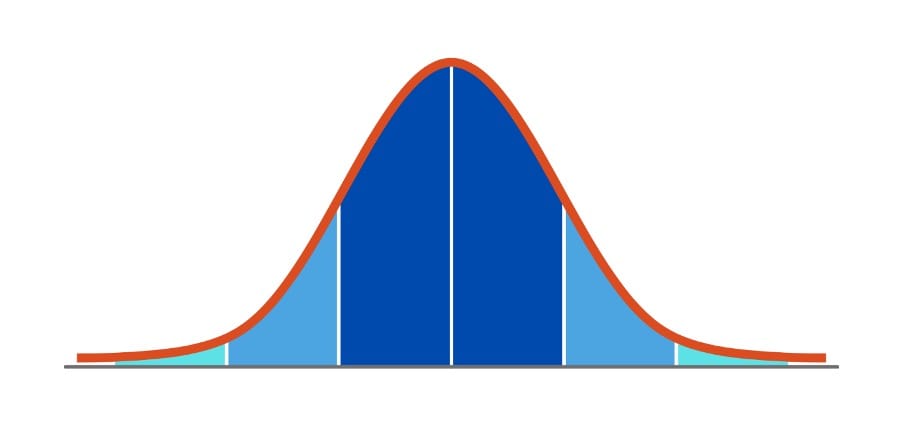
This model allows me to talk about multiple ways of being neurodivergent at once, and also allows space for those of us whose nervous systems are divergent but may not meet criteria for a diagnosis; or who don’t wish to seek a diagnosis (which is perfectly legitimate).
Some terminology
I’m going to use some widely-accepted terminology used in the world of neurodiversity, so here are the definitions if any of these are new to you:
· Neurodivergent: anyone whose mind-body differs from “typical” – the light blue parts at either end of the bell-curve above.
· Neurotypical: anyone whose mind-body is in the “typical” range – the centre of the bell-curve above.
· Neurotype: how your mind-body functions. This includes (but is not limited to) neurotypical people, autistic people, ADHDers, people with OCD, personality disorders, dyslexia, dyspraxia, those with traumatic brain injury, seasoned meditators, and people with a history of trauma.
· Neurodiverse: “diverse” means a group that has a range of different individuals. If a group is racially diverse, the individuals are from a range of races. If a group is neurodiverse, they are from a range of neurotypes.
For a more thorough list of terms I highly recommend Nick Walker’s essay Neurodiversity: Some Basic Terms and Definitions.
Neurodivergent Nervous Systems
If we look back at the first series I wrote, we can see a breakdown of the nervous system into different limbs. Each of these limbs can diverge from the “norm” in different ways, including:
The sensory system
The sensory system is how we experience the world. Our sense of touch, hearing, smell, sight, taste, proprioception, interoception and vestibular sense.
Most forms of neurodivergence involve sensory differences, including:
· Hyposensitivity: being less sensitive to sensory input than most people
· Hypersensitivity: being more sensitive to input
· A “leaky filter”: the filter that neurotypical people use to filter out irrelevant input (the thalamus) is less efficient in neurodivergent people. We may walk into a room and hear every sound, see every colour and light, smell every scent. If there is an annoying sound or a flickering light or unpleasant scent, we may lack the ability to filter it out.
· Bottom-up processing: processing sensory input without the pre-existing knowledge, context and expectations that allow top-down processors to filter out irrelevant input
· Delayed processing: processing input more slowly than neurotypicals
Most neurodivergent people have a mixed profile of these sensory differences. For example, I am hyper-sensitive to sound and cannot filter out sounds easily – I can’t even think if the microwave is on. But I’m hyposensitive to taste, and love spicy and flavourful foods. I process written text quickly, but spoken word much more slowly. Other neurodivergent people might restrict themselves to a small number of known, bland foods because of hypersensitivity. Many neurodivergent people are hyposensitive to pain (nociception).
All of this sensory overwhelm puts pressure on the Autonomic Nervous System, pulling us closer dysregulation.
The Autonomic Nervous System
Put simply, experiencing the world differently means neurodivergent people may live closer to the edge of their window of capacity:
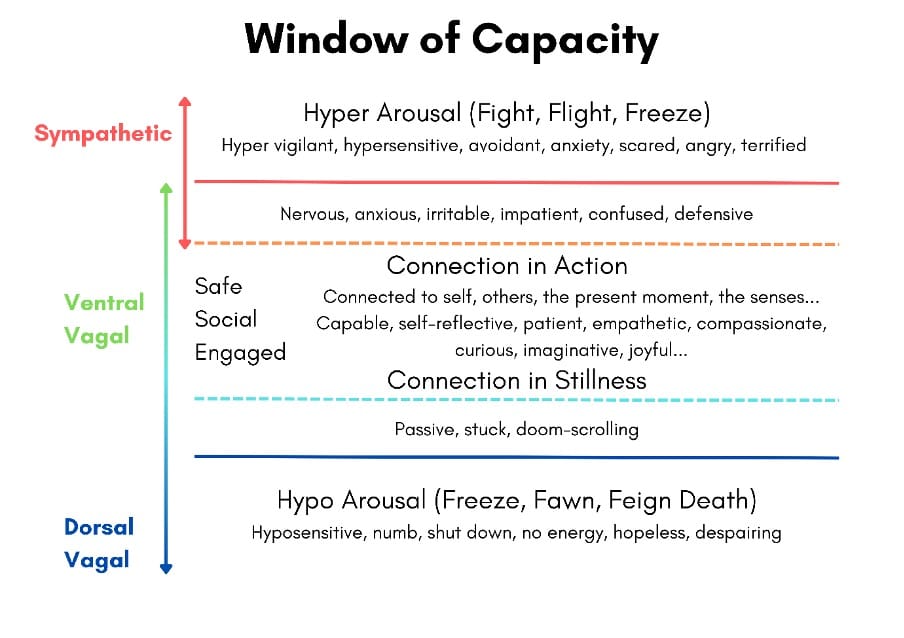
Rather than being comfortably in Ventral Vagal, feeling safe, social and engaged, a neurodivergent person may be at the edge of that window of capacity, closer to fight, flight and freeze at the top of their window, or freeze, fawn and feign death at the bottom.
Overwhelm from sensory input, or communication differences, or masking, or intrusive thoughts, can lead the body to be in hyperarousal, ready to go into survival at the sniff of danger.
Autism is associated with meltdowns and shutdowns, but these are seen in a range of neurotypes, including ADHD, PTSD, OCD, BPD, and others. When we define meltdowns and shutdowns as an overloaded nervous system having a fear response, rather than behaviour of a specific neurotype, we get a much more expansive understanding of neurodivergence and neurodivergent behaviour.
Meltdowns and shutdowns can be mapped onto the autonomic nervous system:
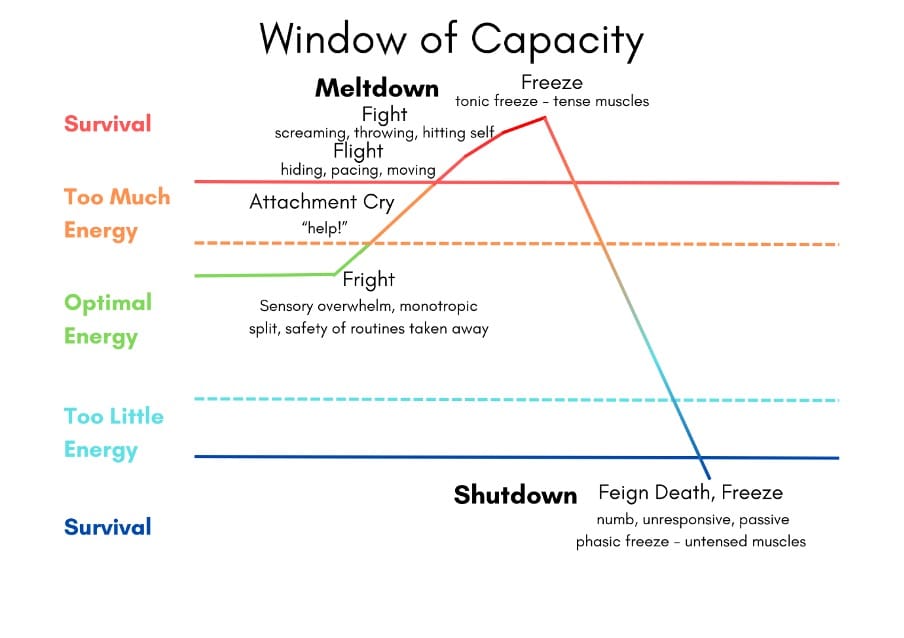
A meltdown is when the autonomic nervous system goes into a fear response. We experience too much or too little of something for too long, without proper resourcing, and our body reacts with pacing and moving, screaming, throwing things and sometimes hitting oneself, and tense muscles. These are the fight, flight and freeze fear responses.
If these don’t work, or they’re not available, we go into dorsal vagal.
Often, a neurodivergent person will have a shutdown because society has taught us that meltdowns are not socially acceptable. Actually, we do cycle through other fear responses, but conditioning has taught us it’s not safe to pace or stim or throw things. Before we’ve had a chance to cognitively process the sympathetic nervous system responses, we plunge down into a shutdown, where we feel numb and unresponsive.
There is an element of intersectionality in this: AFAB people are more likely to have shutdowns if they were shamed for their meltdowns as a child. People of Colour are also more likely to have shutdowns if they were taught as a child that meltdowns could be threatening to them, if others perceive it as dangerous behaviour.
Behavioural Differences
Think of the behavioural differences we see in neurodivergent people as the symptoms of the nervous system differences. While it can be tempting to see autism as, for example, aversion of eye contact or rigid routines, these things are the traits that someone displays when their world is unpredictable and overwhelming, when they take in input without a filter, and when they’ve been told off for the ways they try to deal with this as a child.
Behavioural differences in neurodivergent people include communication differences such as finding eye contact uncomfortable, needing to organise your world with routines and rules, stimming and being clumsy due to proprioceptive differences. Add masking on top, and the world ends up being overwhelming and uncomfortable for many neurodivergent people.
It makes sense, then, that many neurodivergent people have sensory avoidant behaviours; doing our best to not be around the sounds or smells we find overwhelming. But neurodivergent people also have sensory seeking behaviours. This is when we seek out stimulation, either because we are hyposensitive to it or because strong sensation can actually drown out all the background noise.
These sensory seeking and avoiding behaviours, along with the communication differences I mentioned above, are some of the key reasons that neurodivergent people may be drawn to kink.
Next: Neurodivergence and Kink
Once we understand neurodivergence as a nervous system difference, its relation to kink makes more sense. If we have nervous systems that diverge from the norm, it makes sense that many people want to play with that nervous system.
Over the next two posts we’re going to look at why kink can be appealing for neurodivergent people in terms of sensory input and communication, as well as the challenges involved.
Disclaimer: This space centres consent, autonomy, harm reduction, and nervous system awareness. I am not a doctor and this is not medical advice.
You can now access my curated resource library here. There is a whole section dedicated to neurodiversity resources I personally use!