Trauma Part 2: The Body Remembers
Excitement can show up in the body as an elevated heart-rate; as short, shallow breathing. But so can anxiety and anger. The nervous system of a trauma survivor may become activated through excitement but this very activation becomes triggering and is read as fear, anxiety or danger.

Stuck in Survival
Trauma – too much or too little of something for too long – is processed not only in the mind, but leaves its imprints in the body.
During a traumatic incident, our nervous system responds in a protective way. The fear-response takes over in aid of survival, and we fight or flight or shut down.
Without proper resourcing, and with repeated or unresolved traumas, we get stuck in survival: a state of hypervigilance, where we are constantly looking for threats.
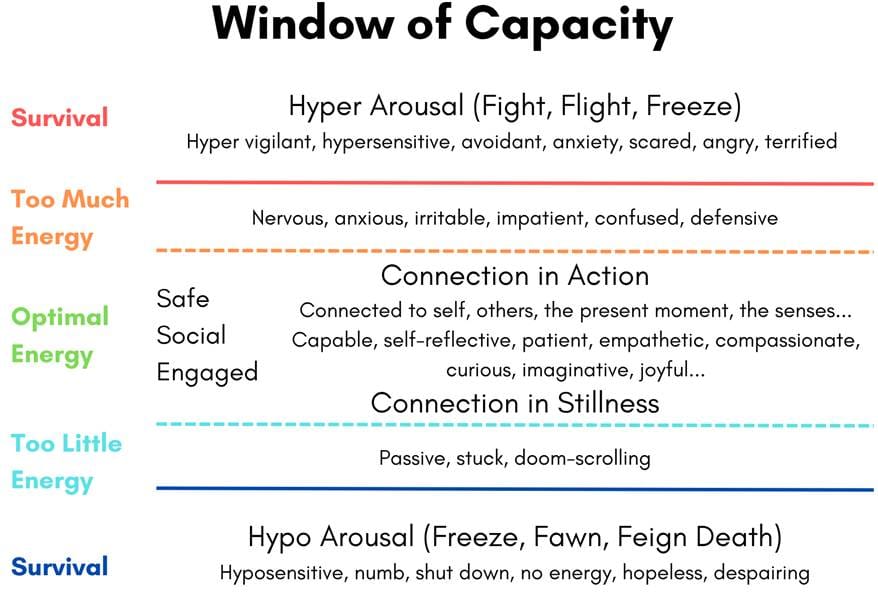
If we think of this “stuck in survival” in terms of our nervous system, we are stuck at the edge of regulation, ready to go up into sympathetic survival or to collapse down into dorsal vagal survival at any moment.
Switching between nervous system states is metabolically taxing, and conserving energy is what the body does best. It’s more energy efficient to stay at the edge of regulation, ready to switch into survival at any moment:
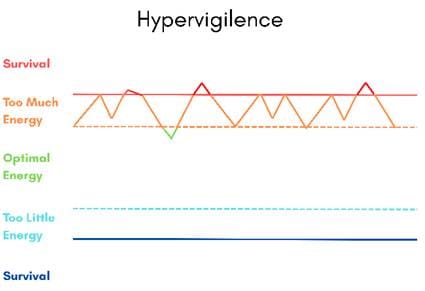
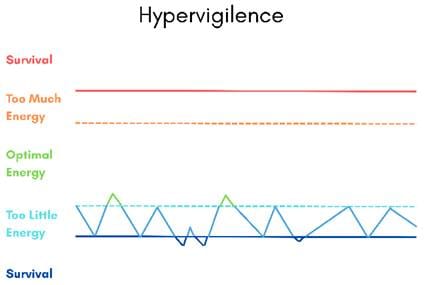
In the body, this can feel like too much energy if your nervous system sits at the edge of sympathetic: anxiety, tension, anger. Or it can feel like too little energy if your nervous system sits at the edge of dorsal vagal: passive, stuck, hopeless. Anxiety and depression: two sides of the same coin, two reactions to the same issue of being stuck in survival.
Trauma in Kink
Trauma shows up in the body in different ways, and these can impact on how a trauma survivor may experience kink.
Survivors of Childhood Sexual Assault (CSA) have both hypersensitivity and hyposensitivity to stimuli: that is, they may feel extremely sensitive to some input, and not to others.
This may seem paradoxical, but, viewed through the nervous system lens above, it makes complete sense. A hypervigilant nervous system is going to be hypersensitive to input, while the dorsal vagal response is associated with numbness and disconnection.
This could mean that input that feels grounding for one person can overwhelm another. Input that is fun for one person can trigger another.
What’s more, during kink scenes our nervous system is naturally more activated; that tipping point is even closer.
While this is the case across all of kink, it is especially true for trauma survivors and neurodivergent individuals (more on that in my next series!) because of the ways our nervous systems react differently to sensory input.
Excitement can show up in the body as an elevated heart-rate; as short, shallow breathing. But so can anxiety and anger. The nervous system of a trauma survivor may become activated through excitement but this very activation becomes triggering and is read as fear, anxiety or danger.
This can be one place where a list of triggers and glimmers can support a good negotiation: being able to say to your partner(s) that “this smell triggers me” can not only help you avoid that smell during the scene, but also help you to feel safer knowing you have expressed that.
Capacity for Play
What trauma took from many people was the capacity for playfulness.
When trauma is stuck in the body; when we are stuck in survival, our capacity for play remains impeded. We are hypervigilant to threat, leading to frozen movement patterns and a lack of spontaneity.
Kink can be a kind of play, the way dance or movement can be. We can use kink as a way to teach our body that it is safe It can be a way to explore your own body and others', to express yourself and to connect.
In order to explore kink as play, we need to start from a point of nervous system regulation, which starts from a felt sense of safety. A regulated nervous system can accurately assess situations as safe, whereas a dysregulated nervous system will often read safe situations as being unsafe.
Dysregulation
A dysregulated nervous system can show up in different ways during a scene; and it’s worth remembering that the trigger may be nothing to do with the scene.
Someone could enter into a scene already dysregulated: from their day; from built up stress; due to their menstrual cycle.
Someone could be triggered by something else that is going on around them: loud sounds; a smell; a passing conversation.
Or, it could be due to the scene – but that doesn’t mean it’s anyone’s fault. Maybe the scene was desirable when it was an idea, but now it’s happening it’s actually too much. Maybe you didn’t even know what you wanted during the negotiation.
And now you’re dysregulated and having a fear response: an alert nervous system (fight, flight, freeze) or nervous system flop (collapsing, dissociating, fawning).
Whether you are the one who is dysregulated or someone you are playing with becomes dysregulated, it’s important to frame this as protective, not defective. The response, whatever it is, is a coping mechanism.
Freefall
When core needs in a scene are unmet and someone becomes dysregulated, we can also go into a freefall state.
Freefall is distinct from drop: it describes a state where someone's core needs in a scene are going unmet, and they lack the capacity to say so.
The hope in any scene is that all parties feel capable of ending the scene if they feel uncomfortable, but this isn’t always the case. If we grew up with an expectation that we would be uncomfortable and have to “push through” it, it can feel very threatening to end a scene; whether we are the top or the bottom.
It’s therefore worth knowing the signs of freefall so you can identify them in a partner.
Freefall looks different for different people, but is mostly marked as a change from what your behaviour would normally be.
For example, brattiness is common in scenes, but submissive freefall can also look like brattiness. For someone who is not normally bratty it can be a way to protest the way a scene is going in a way that feels safe, or a way to regain some control. Other signs are over-apologising, clumsiness, heightened anxiety, or unusual need for reassurance.
Dominant freefall may look like increased feelings of irritability, guilt or fear of wrongdoing; micromanaging the scene and heightened self-criticism.
The challenge with freefall is that it can look like the scene itself – this is why regular check-ins, safe-words and robust negotiations are important. Asking your partners how they react when their needs are unmet could be an important part of a negotiation: telling someone “I tend to people-please when I’m triggered” can be the crucial information needed before a scene to ensure it doesn’t become too much for you.
But dysregulation is only one part of the picture: the other side of the same coin is intensity.
Intensity
Intensity in a scene can be deeply therapeutic if done properly.
When animals are threatened in the wild, they have a fear response followed by “completing the cycle” once they are safe. They shake, move, yawn. This helps them to physiologically move on from the trauma.
Humans, somewhere along the way, have lost this response, and it can be helpful to deliberately “complete the cycle” regularly to reset the nervous system. Intensity can be one way of doing this: working out, dancing and kink can all be ways that the body can move through a response it was unable to finish.
Kink can be intense without being dysregulating. We can have scenes that are intense and present and embodied.
And this intensity can be up at the activated end of our nervous system, with elevated heart-rate or breathing; or it can be down at the disconnected end, as a mindfulness-adjacent state of disconnection but with embodiment and a felt sense of safety.
Closing
In closing, I want to come back to the idea that, no matter how you react in and out of scenes, these coping mechanisms are protective, not defective. Framing like this can be helpful to stop blaming – whether we go to self-blame (“I’m so stupid for not saying I don’t like this”) or other-blame (“It’s my parent’s fault that I reacted like that”); it can lead to further disconnection from the present moment.
Instead – and if possible – you can acknowledge what happened (“I got triggered and now I’m people pleasing instead of ending the scene”), thank that part of you (“I needed to people please in the past to stay safe, this part of me kept me alive when I needed it the most”) and try a new, adaptive response (“but I’m not unsafe now and I can ask this to end”).
The first time you do this, it can be triggering in itself. If you were taught that advocating for your needs was unsafe, of course it will feel unsafe to do it. You could practice it with a partner, if this makes it easier – out of a scene, and then maybe do a scene with the expectation that you will ask for changes.
Slowly, over time, teach your nervous system that it is safe.
That way, kink can be healing.
We will go into this in more detail next time, in the final part of the series.
Disclaimer: This space centres consent, autonomy, harm reduction, and nervous system awareness. I am not a doctor and this is not medical advice.
You can now access my new curated resource library here: